Intrinsic resistance: how bacteria are out-evolving us!
Intrinsic antibiotic resistance
Without diving too deep into the definition of the word intrinsic, we are going to explore the massive world of the microorganisms surrounding us. In detail, this post is all about bacteria and their natural ability to withstand antibiotics.
It is well known that many bugs slowly but steady become less susceptible to antibiotics because of our mishandling of antibiotics. However, the so-called intrinsic resistance is a totally different story. In general, this is all about bacteria being resistant against toxic components because of time and evolution. Simple as that.
Therefore, it is clear to say, that antibiotic resistance are not only a man-made problem. Instead, we are adding to an already existing problem by the misuse of antibiotics. The emergence of new defensive mechanisms in order to survive is a natural process – the way we often deal with antibiotics is just the fuel that speeds that whole thing up… massively!
Adaption, adaption, adaption
To understand how bacteria slowly but steady start to out-evolve us, we need to understand where most of the antibiotics used today come from. Even though medication, which helps as dealing with infectious diseases, might sound like it is developed in scientific labs, the majority of relevant antibiotics is derived from molecules produced by soil microorgansims (Nesme and Simonet 2014). We only have to look at the history of antibiotics to see, that Alexander Fleming back in 1928 discovered (by accident), that Penicillium releases ‘bacterial growth inhibiting substances’ in its environment. Still it is true, that most antibiotics are nowadays produced in huge bioreactors – but never forget where they actually come from!
Fun-fact: antibiotic substances are not only inhibiting growth of certain bacteria – they also act as a signal molecule between some microorganisms. (Martinez 2008).
To finally solve the puzzle and understand how antibiotic resistances emerge in natural habitats we have to dive into evolutionary theory. And there is no way of talking about evolution without talking about Charles Darwin who shaped the principles of ‘co-evolution’, ‘natural selection’ and ‘survival of the fittest’. In general, it’s all about the surviving by being adapted to the environment. In our case (a natural habitat (e.g. soil) filled with antimicrobial substances) this means being adapted to the toxic compounds released by other microorganisms. Also including the antibiotic producers themselves as it is probably not their main goal to inhibit their own growth.
However, producers are not releasing antibiotics into their environment for nothing. They are competing for nutrients and space. Therefore, only bacteria that learn to handle these antimicrobials, can continue competing with antibiotic producers. This toing and froing is as common in the evolution, that it even got a whole theory named after it: the ‘Red Queen Theory’ – named after the ‘Red Queen’ from Alice. Yes this Alice – the one from Wonderland. How says biologists are not creative? The biologist Leigh van Valen used the quote ‘Now, here, you see, it takes all the running you can do, to keep in the same place.’ to hypothesize, that all animals, plants and microorganisms underlie constant evolutionary pressure. They simply have to evolve in to be able to compete with their neighbors and keep their ecological niche
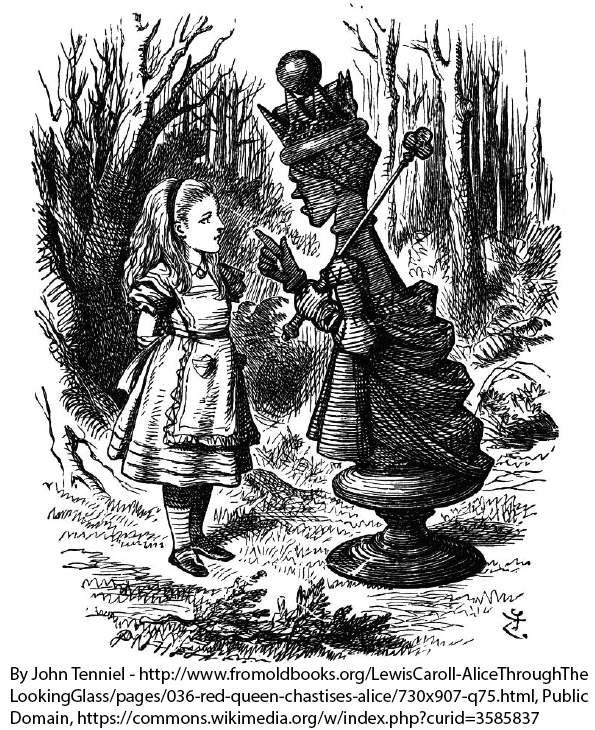
Long story short – life is cruel.
Examples of intrinsic resistance
Sofar we learnt a lot about intrinsic reistance – time to move on to some real-life examples.
First of all, I want you to imagine a basement (ideally your basement so you can feel emotionally connected to it) which is the equivalent to the bacterial cell. Then think about your basement being threatend by flooding, which is the equivalent to the antibiotic making its way into the cell.
What would you do, to prevent the water damaging your basement?
You would probably try to get your hand on some of those sandbags to keep the water out in the same way bacteria try to make their cell wall impermeable to the antibiotic. Simple idea, but very effective!
But let’s consider all sandbags were out (damn neighbors!) our you couldn’t react that fast. What other possibilities to we have? Well we probably could focus on the most important things in our basement and make sure they don’t get drowned in water. Bacteria are doing exactly the same by hiding potential targets of the antibiotics, so it can’t work as designated.
Some of you might think of using a water pump (or bucket for the ones looking for a low-budget solution) to get rid of the water. And again – you guessed it – we can find a similar mechanism of action in bacterial cells. By the use of efflux pumps they can get rid of harmful substances.
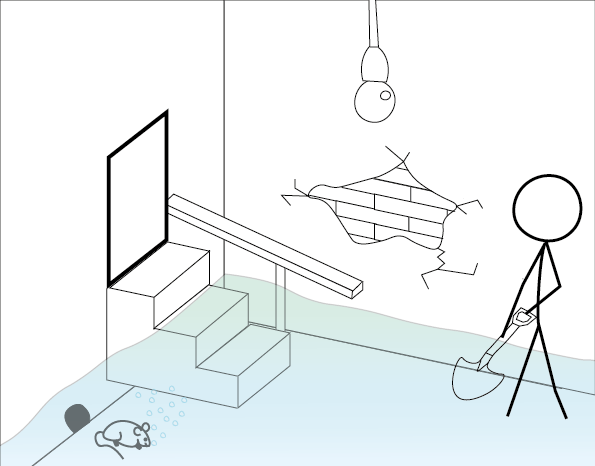
Let’s assume the worst case scenario now. You didn’t get any of those damn sandbags, your bucket is full of holes (which is why you chose the ineffective shovel) and you have no money for a water pump. Well, you are actually screwed. Or putting it into the words of the ‘Red Queen’ you didn’t do all the running you can do. But it was nice to have a basement in the first place…
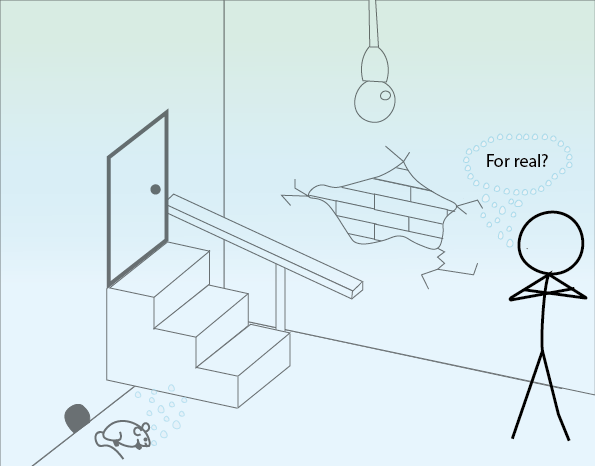
Apart from your tragic loss you may just have learned the basics of intrinsic antibiotic resistance. Nature did come up with lots of defensive strategies long before we even thought about using antibiotics to treat infectious diseases. However, this doesn’t mean we are innocent. Keep in mind that we are speeding up that natural process massively!
Nature > Humans
The assumption, that antibiotic resistance is just a man-made problem is wrong. Maybe we had that theory for so long because we do think we are the center of the universe. In reality, nature handles most of the processes all by itself. We may add to it, or try to compete with it, but we will never be able to control nature. We have to learn this sooner than later to fully understand antibiotic resistances and keep the medication we have working for as longs as possible. In fact, one thing is clear: our planet and its microbial community are not reaaaaally caring about us. They were here before us, and they are likely to be here when we’re gone. Nature > humans – even if we’re living in the so-called anthropocene.