Friend or foe?
Are antibiotic-resistance genes evil? The answer is a clear ‘no’. They can severely obstruct the successful treatment of infectious diseases, but from a neutral perspective they are products of nature – more precisely, of evolution. Although we contribute substantially to the emergence and spread of new resistance, it is worth remembering that antibiotic resistance existed long before the discovery of penicillin. Nor do these genes prevail because bacteria are secretly devising diabolical plans to subjugate humanity. They are defence mechanisms that help bacteria survive.
Admittedly, pathogens do not necessarily need such effective protection – but we are partly responsible for that situation ourselves.
NDM-1
Antibiotic-resistance genes are remarkably abundant. More than 6,000 resistance genes have, for example, been found in the human gut microbiome (Ruppé et al. 2018). Anyone seeking an overview of the extraordinary number of known resistance mechanisms should take a look at the international CARD database.
The enormous number of DNA fragments that can confer antibiotic resistance makes it all the more difficult to choose a single one for a closer look – but that is exactly what we are going to do.
Our choice is NDM-1, or by its full name: New Delhi metallo-beta-lactamase 1.
Why this particular gene? Let us take a brief look at its history.
First identified in 2008 and named after New Delhi, NDM-1 has since been detected in more than 70 countries – and even in the Arctic. The Arctic finding was close to an Indian research station, but it was still the Arctic.
Its spread is concerning enough, but one property makes NDM-1 especially problematic: New Delhi metallo-beta-lactamase 1 can confer multidrug resistance.
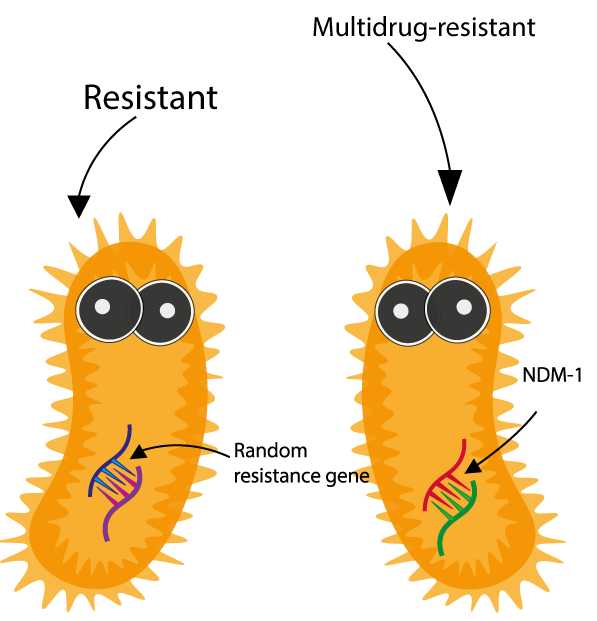
Nearly all beta-lactam antibiotics are ineffective against bacteria carrying this gene. These drugs include penicillins as well as carbapenems, which are among our most powerful treatments for severe bacterial infections and are often regarded as a last resort.

What can we do?
We established at the beginning that antibiotic-resistance genes are not inherently evil, even if that may be difficult to believe after the rest of this article. But because humans are also subject to evolutionary processes, we will hopefully not simply sit back and drink tea.
For now, the principal measures available to us include surveillance, isolating infected patients, careful hand hygiene, and disinfecting equipment and places that have come into contact with the affected person. Raise your hand if that sounds familiar from measures used to contain COVID-19.
In the long term, however, we will need additional solutions for NDM-1. Although this gene represents an extreme case, it is only one of many genes contributing to the global problem of antibiotic resistance. Research into bacterial defence mechanisms and alternative treatment options must be pursued far more vigorously if we are to avoid a post-antibiotic era.